The Weekly Mash, Friday January 15, 2026

The news that the Fielden brand has been sold by Still on The Hill [SOTH] to brand agency Glass Half Full [GHF] was, while sad, not entirely unexpected, give its reliance on funding from Diageo’s brand accelerator arm, Distil Ventures [DV]. The upside is that Glass Half Full has said that the brand is safe and it will invest in it.
The removal of the Diageo/DV funding left [SOTH] an impossible situation: it was already committed to supply contracts with 15 farms while plans for a new distillery, a central grain processing site, warehousing, crop research and brand building were all under threat. SOTH searched for a new investment partner but, after that came to naught, the decision was to sell.
Distilleries closing and firms folding is, unfortunately, going to be a recurring story over the next few years. The reasons why they have failed will be varied. Fielden’s case points to deeper issues which are surfacing within the wider industry.
Though analysing with the benefit of hindsight can be somewhat smug, any brand entirely reliant on funding from DV was always going to be exposed: the chances that the sugar daddy might walk away was always there, but you can understand the attraction to niche whisky producers. The DV portfolio contained some of the most fascinating new whisky firms in the world. They were all members of a gang which was asking what 21st whisky could be.
The callous dropping of finance, at a time when the industry was in a febrile state, and knowing what the result would be, demonstrates that it is the City which decides strategy, putting the majors into a blind panic. The result haas been a quitting of any notion of long-term thinking and planning. This runs counter to everything that you used to be told about whisky – that it needs time and it needs patience. The DV distillers fitted that old model, but not the new.

Fielden’s strategy was a bold one, attempting to link whisky properly, seriously with farming, re-establishing it as an agricultural product, creating a matrix between soil, crop, and product. It was about sustainability, just sadly at a time when it’s become apparent that in the majors’ thinking any project which doesn’t bring a quick return is not sustainable.
The Fielden sale also reinforces the wider feeling that investors are leery about backing any long-term project. If new players in a long-established (and therefore sound) whisky category such as Scotch are also faced with this, then it is even more of an issue for new countries in the early stages of their development.
You need investment to build your brand, yet you cannot tell said investor exactly how the market will play out. Whisky doesn’t fit into financial orthodoxies – if you’re lucky, the first profits might only appear a decade after the initial investment and top-ups will be required throughout that process. It’s madness. It is also why DV seemed to make sense – Fielden and the other brands affected were backed by a firm which understood all of this. Or so we thought.
The deeper issue is what this says about how seriously new ways of thinking about whisky are taken. There was a recent piece – another bloody list – about ‘the most innovative brands of 2025.’ It included a pizza-flavoured vodka, some gins with people buggering about with botanicals and, top of the tree, Chivas’s clear whisky-not-whisky.
If those are innovations then pack your bags folks, we’re doomed. Look instead at what is happening on the margins, because that is where the true smart thinking is and where investment is needed. It is at the centre where the sickness lies.
My concerns here aren’t that SOTH had no option other than to sell but, rather, that the end of DV, or the pulling of financial support for any distillery, is ‘just business,’ that it doesn’t matter. The thing is, it does matter because without these thinkers on the margins, whisky stagnates.
If these smaller players are under increasing financial pressure, might we see like-minded alliances forming? What is clear is that they have to survive and if the big firms are unreliable partners, new thinking is required.
I’m glad that GHF sees it that way and that Fielden continues to exist. We’ll have to wait and see what its new owner’s approach will be. It has bought a whisky without a distillery, though that does beg the question that if the industry is over capacity does each whisky need a dedicated production site? If brewers and wine producers share space, then why not whisky?
If Fielden is, as the name suggests, about the field, does it even need to be an English whisky? Can it be an international brand working with farmers and like-minded producers globally? Extend the matrix in other words. We’ll see.
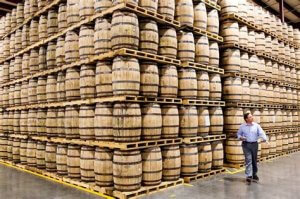
The issue of over capacity will continue to dominate this year. With warehouses still full, it will take time – another year, maybe two to fully resolve itself. Production needed to be cut back, but the need for an adjustment was evident some seven or eight years ago. A gentle easing off the gas, similar to what happened around 2000, was required to bring things back into line. Instead, the foot stayed on the accelerator, meaning that the current adjustment has had to be extreme.
It was the result of the majors badly misreading the market – not the small volumes added by new producers. The effect hasn’t simply hit producers, but farmers, maltings, transport – the whole whisky ecosystem.
A lot of cleaning will continue this year with, hopefully a return to a degree of normalcy in terms of production by year end. What, though, about the other end of the pipeline? Whisky has to sell. I’ve said this before… people are not turning away from whisky per se, they are unable or unwilling to pay over-inflated prices. If production needs adjustment, so does pricing.
The fact is, people are still drinking – the questions that the industry has to ask is what are they drinking, how and where are they drinking it and what can whisky do long-term to fit itself into their worlds?

New brands might be needed, but they must be compelling and not contrived. Single malt for sure but might this be an opportunity for new blends to attract new consumers? (yes, I’m looking at you Woven, Turntable, Two Stacks and Foxes Bow).
Pricing needs to be addressed, but what can’t happen is a return to the commodity market of the ‘80s and ‘90s. There is a difference between great value and cheap: the latter damages image, removes any above the line support, and reduces whisky to commodity. Great value is based around quality of product and story and selling at an affordable price.
Do economies of scale mean that smaller, newer players will be unable to play in this area, further increasing the financial pressures? Not necessarily, as long as they can keep their prices sensible and the story genuine.
The reason for buying a whisky goes beyond a price tag or perceived ‘value for money’. People are not buying solely with their wallet. They are still choosing. The trick therefore is to have all the reasons for purchase in alignment: price is important when people are under financial pressure, but so is quality (it’s odd how often that is forgotten), and also the story: how true it is, how it affects, and inspires. In other words, it’s more than just bunging some mature whisky into a PX cask, calling it innovative and hoping for the best.

With bulk prices falling and the doors of distillers’ warehouses open once again, an energised independent bottler sector may emerge with a wider range of distilleries – and ages. While there are concerns that we may see more armchair bottlers with a buy-it, bottle-it approach, the hopes are that the sector will be dominated by those who make considered purchases based on quality and release bottles when ready, not just for cash flow.
It won’t be easy, because all of this is taking place in the face of a global trade war whose rules of engagement change every day.
Tariffs will hurt Scotch, but will be more acutely felt by Irish whiskey because of its over-reliance on the US market, Likewise US whiskey – which is in an equally bad state in terms of over-capacity will find it hard to reach the new markets it needs to ease the pressure.
Are there bright spots? Africa is being talked up and offers opportunities for medium and smaller brands. Central Europe has potential, especially for newer producers as a smaller emerging market isn’t as attractive for the big players – there are bigger fish out there.
It won’t be easy but there are great whiskies out there, great value to be hand and a great love for the product, no matter where it is from. Whisky is resilient. It will survive but calm heads and a willingness to look at the long-term is what is required. Who has the patience?
Happy New Year everyone!